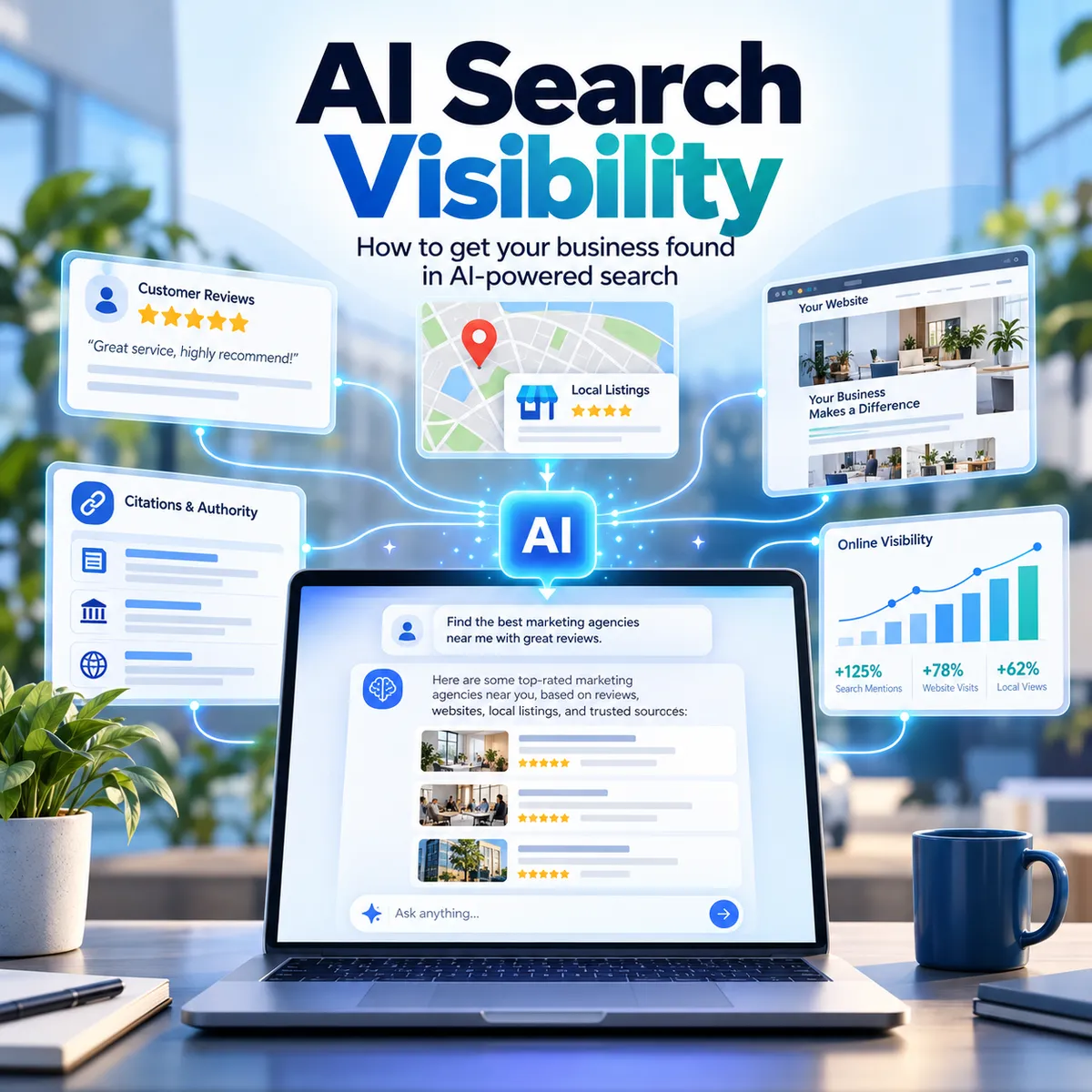
Search is changing quickly.
Consumers are no longer relying exclusively on Google to find businesses, compare providers, or research products and services. Increasingly, they are asking platforms like ChatGPT, Gemini, Perplexity, and other AI-powered search tools for recommendations.
Instead of searching:
“HVAC company Denver”
someone may ask:
“Who is a reliable HVAC company in Denver that offers emergency service and has good reviews?”
That difference matters.
Traditional SEO is largely focused on helping your website rank in search results. AI visibility is about helping artificial intelligence platforms understand your business well enough to mention, cite, or recommend it when someone asks a relevant question.
For businesses, this creates an entirely new layer of digital visibility.
The good news is that many of the factors that help with traditional SEO also help with AI search. The difference is that AI engines tend to evaluate a much broader collection of information about your business.
Here are some of the biggest factors that can influence whether your brand appears in AI-generated results—and what you can do about them.
What Is AI Search Visibility?
AI search visibility refers to how frequently and accurately your business appears when consumers use AI-powered platforms to research companies, products, services, or recommendations.
For example, a homeowner might ask:
- “What are the best roofing companies near me?”
- “Who offers emergency AC repair in Tampa?”
- “What digital marketing agencies specialize in home services?”
- “Which wealth management firms work with anesthesiologists?”
- “What pediatric dentists are recommended in South Tampa?”
The companies appearing in those responses are gaining exposure before the customer ever reaches a traditional search engine results page.
That means businesses should begin thinking about their presence across two different search environments:
Traditional search visibility: Where your website appears in Google or Bing.
AI visibility: Whether AI platforms understand, trust, reference, and recommend your brand.
The two overlap, but they aren’t identical.
1. Make It Extremely Clear What Your Business Does
One of the simplest ways to improve AI visibility is to eliminate vague marketing language.
Consider these two descriptions:
Option A:
“We provide dependable solutions and outstanding customer service.”
Option B:
“We provide residential roof replacement, storm damage repair, and emergency roofing services throughout the Denver metro area.”
The second description gives an AI system substantially more information.
It explains:
- What the company does
- Who it serves
- Where it operates
- What types of services it provides
AI systems need context to determine whether a business is relevant to someone’s question.
If your messaging is overly broad, inconsistent, or filled with generic marketing language, it becomes harder for search engines and AI platforms to confidently understand where your company belongs.
How to improve your positioning
Review the primary places where your business is described, including:
- Homepage copy
- About page
- Service pages
- Google Business Profile
- Social media profiles
- Directory listings
- Page titles and meta descriptions
- Industry profiles
Your core positioning should remain relatively consistent everywhere.
You don’t need to copy the exact same sentence across every platform. The important thing is that the same services, specialties, industries, and geographic areas are clearly communicated.
2. Build Reviews That Provide Useful Context
Reviews have always played an important role in local marketing.
In an AI-driven search environment, the details contained within those reviews may become even more valuable.
Compare these examples:
Review 1:
“Great company. Highly recommend.”
Review 2:
“Our air conditioner stopped working during a 95-degree weekend. They came out that afternoon, replaced the failed capacitor, and had our system running again within two hours.”
Both are positive reviews.
But the second review contains much more information.
It identifies:
- The service performed
- The customer’s problem
- The urgency of the situation
- The outcome
That type of context can help reinforce what your company is known for.
Encourage customers to be specific
Businesses shouldn’t tell customers exactly what to write or manufacture reviews.
Instead, simply encourage customers to describe their experience.
For example:
“If you have a moment to leave us a review, we’d really appreciate it. Feel free to mention what service we helped you with and how your experience went.”
This naturally produces reviews that provide more useful information to both potential customers and AI platforms.
3. Keep Your Business Information Consistent Across the Internet
AI platforms don’t evaluate your website in isolation.
They may encounter information about your business across dozens of other sources.
That can include:
- Google Business Profile
- Bing Places
- Yelp
- BBB
- Industry directories
- Chamber of commerce websites
- Local directories
- News websites
- Association websites
- Review platforms
If those sources provide conflicting information, it becomes harder to establish a clear picture of the business.
Common problems include:
- Old phone numbers
- Previous addresses
- Incorrect business hours
- Duplicate business listings
- Inconsistent business names
- Old service areas
- Outdated website URLs
Maintaining accurate business information across these platforms has long been a component of local SEO. It may become even more important as AI systems attempt to verify companies across multiple independent sources.
4. Build Authority Outside of Your Own Website
Your website saying you’re the best company in your market doesn’t necessarily make it true.
Independent references carry more weight.
AI platforms can look beyond your website when researching a company, which means third-party mentions may help strengthen your brand’s authority.
Examples can include:
- Local news coverage
- Industry publications
- Podcast appearances
- Community sponsorships
- Association memberships
- Local event participation
- Expert interviews
- Guest articles
- Reddit discussions
- Industry forums
- Local blogs
For example, imagine two roofing companies with nearly identical websites.
One exists primarily on its own website and Google Business Profile.
The other has been mentioned by a local newspaper, sponsors a community event, belongs to a regional builders association, has hundreds of detailed reviews, and regularly contributes educational information online.
The second company provides AI systems with substantially more independent evidence that the business exists and has expertise within its market.
This is where digital PR, SEO, community involvement, content marketing, and brand building increasingly overlap.
5. Create Content Around Real Customer Questions
Traditional SEO strategies often begin with keywords.
AI optimization should also consider questions.
People interact with conversational AI differently than they interact with Google.
Someone may search Google for:
“roof replacement cost Alabama”
but ask ChatGPT:
“How much should I expect to pay to replace a 2,500-square-foot roof in Alabama?”
That means businesses should create content that answers detailed, conversational questions.
Useful topics might include:
Home Services
- How much does HVAC replacement typically cost?
- Repair or replace: When does an air conditioner need replacing?
- How long does a roof replacement take?
- What should homeowners do immediately after storm damage?
Legal Services
- What should I bring to my first divorce consultation?
- How long does the divorce process usually take?
- When should I hire a specialized attorney instead of a general practice lawyer?
Healthcare
- What happens during your first consultation?
- How much does treatment typically cost?
- What is the difference between treatment A and treatment B?
B2B Services
- How much should a company spend on digital marketing?
- Should we hire an internal marketing team or an agency?
- Google Ads vs. LinkedIn Ads: Which works better for B2B lead generation?
These topics match the natural language people increasingly use when interacting with AI tools.
6. Move Beyond Generic Service Pages
A website containing only a homepage, about page, service list, and contact form gives search engines limited information.
Individual pages should go deeper.
Instead of having a page called:
HVAC Services
consider creating pages and resources such as:
- Emergency HVAC Repair in Denver
- Furnace Repair for Older Denver Homes
- Heat Pump vs. Gas Furnace: Which Is Better?
- Average HVAC Replacement Costs
- What to Do When Your Furnace Stops Working
Instead of:
Digital Marketing Services
a marketing agency could create:
- Digital Marketing for Roofing Companies
- Google Ads Management for Home Service Companies
- Meta Advertising for Ecommerce Brands
- Google Ads vs. Meta Ads for Lead Generation
- How Much Should a Business Spend on Paid Media?
Specificity creates more opportunities for both search engines and AI platforms to associate your company with a particular topic.
7. Structure Content So Answers Are Easy to Find
Content should be useful to people first.
But good structure also makes information easier for search systems to understand.
Effective pages frequently include:
- Clear headings
- Short paragraphs
- Frequently asked questions
- Bullet points
- Comparison tables
- Definitions
- Step-by-step explanations
- Pricing information where appropriate
- Geographic context
- Service-specific information
Instead of burying an answer inside 2,000 words of copy, answer important questions directly and then provide supporting detail.
This improves usability while also making information easier to retrieve and reference.
8. Strengthen Your Local Signals
Local businesses have another important consideration: geographic relevance.
If you serve specific cities, counties, or neighborhoods, make that clear throughout your digital presence.
This could include dedicated location pages, local service content, accurate Google Business Profile information, local reviews, community mentions, and location-specific FAQs.
For example, a company serving multiple markets may benefit from individual pages such as:
- Roof Repair in Denver
- Roof Replacement in Aurora
- Storm Damage Repair in Lakewood
- Commercial Roofing in Boulder
These pages should contain genuinely useful information rather than duplicating the same page and swapping the city name.
9. Test How AI Platforms Currently Describe Your Business
You can’t improve your AI visibility without knowing where you currently stand.
One of the easiest ways to begin is by running the types of prompts your customers might actually use.
Try several AI platforms, including ChatGPT, Gemini, Perplexity, and Google’s AI-powered search experiences.
Search questions such as:
- “What are the best [service] companies in [city]?”
- “Who specializes in [specific service] near me?”
- “What companies would you recommend for [problem]?”
- “Compare the top [industry] providers in [location].”
- “Who has good reviews for [specific service]?”
Then document the results.
Look for:
- Whether your company appears
- Which competitors appear
- How frequently competitors are mentioned
- How your business is described
- Whether the information is accurate
- Which websites or sources are being cited
AI-generated answers can vary by platform, prompt, location, and over time, so don’t treat a single query as definitive. Instead, look for patterns.
10. Compare Your Digital Footprint With Competitors
If competitors consistently appear in AI recommendations and your business does not, investigate why.
Compare factors such as:
| Signal | Your Business | Competitor |
|---|---|---|
| Detailed service pages | ||
| Location-specific content | ||
| Recent reviews | ||
| Detailed reviews | ||
| Directory consistency | ||
| Industry mentions | ||
| Local media mentions | ||
| FAQ content | ||
| Comparison content | ||
| Strong Google Business Profile | ||
| Backlinks and authority |
This turns AI visibility from an abstract concept into something you can actively work on.
SEO Isn’t Going Away
The rise of AI search doesn’t mean traditional SEO is dead.
Quite the opposite.
Strong technical SEO, quality content, backlinks, local optimization, structured information, and established authority still provide much of the foundation AI platforms rely on when discovering and evaluating businesses.
The difference is that businesses now need to think beyond rankings.
Your overall digital footprint matters.
Your website, reviews, directory listings, online conversations, media mentions, industry presence, and content all contribute to how clearly your company can be understood.
AI Visibility Is Ultimately About Clarity and Authority
There isn’t a single switch businesses can flip to suddenly appear everywhere in AI search.
Instead, visibility is built by creating consistent signals across the web.
The businesses positioned well for AI-driven discovery tend to have several things in common:
- Clear positioning
- Strong service-specific content
- Accurate business information
- Consistent local signals
- Detailed and recent customer reviews
- Third-party mentions
- Demonstrated subject-matter expertise
- Content that answers real customer questions
The objective is simple:
Make it easy for both people and machines to understand who you are, what you do, where you operate, and why your business is credible.
Companies that invest in those fundamentals aren’t just optimizing for ChatGPT or the next generation of search engines.
They’re building a stronger digital brand overall.
Want this working for your brand?
KEEN plans and runs paid media, SEO and social programs for brands across the US. Tell us what you're trying to grow.
Talk to a strategist →